

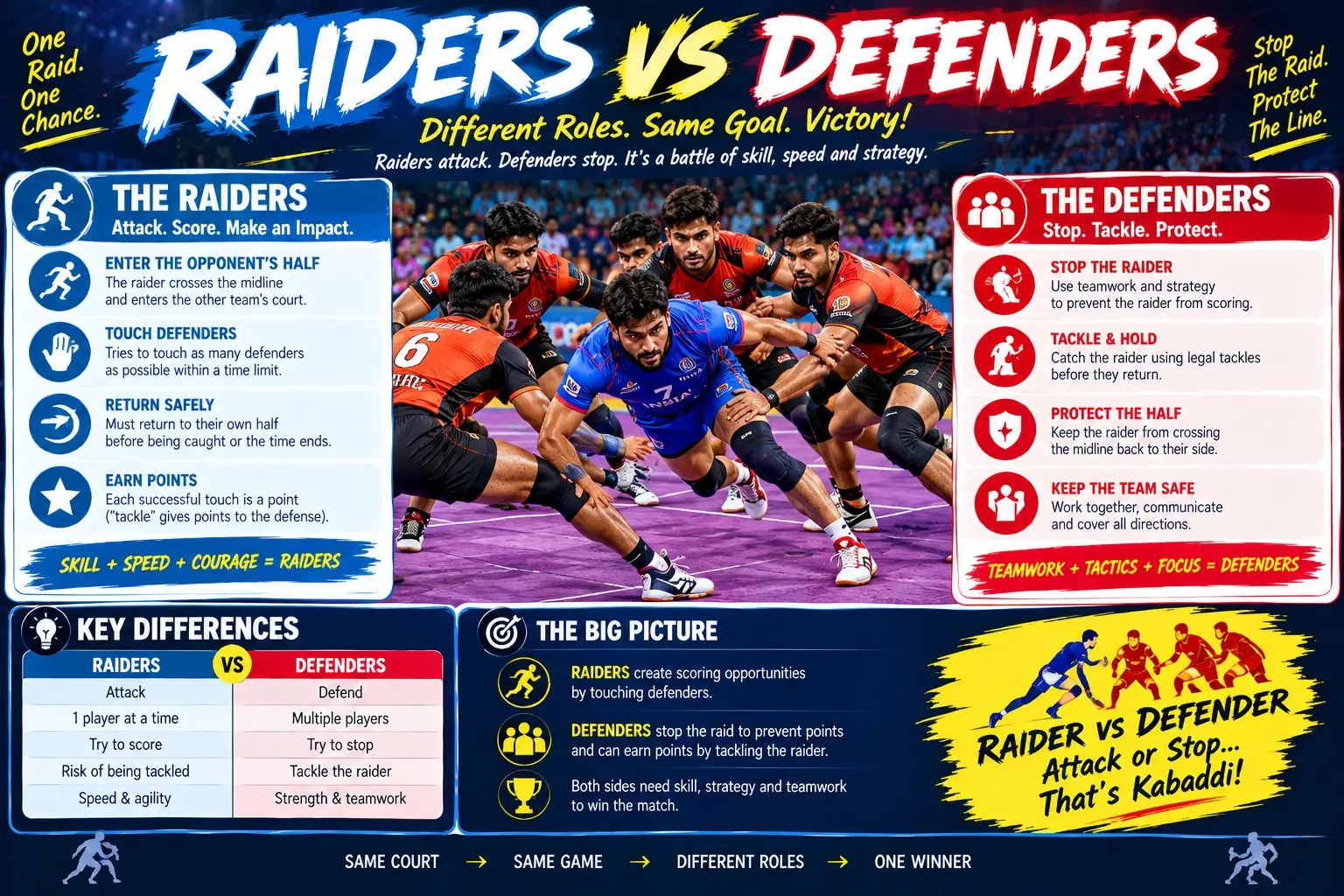
Kabaddi may look like a simple contest — one raider crosses the midline, tries to touch defenders, and sprints home — but beneath that breath-held duel lies one of team sport's most elegant role division. Every kabaddi team is split into two functional armies: raiders, who attack in isolation and score by touch, and defenders, who coordinate as chains to tackle and punish. Each role demands a distinct athletic profile, skill set, tactical intelligence, and psychological temperament. Understanding how raiders and defenders perform different roles is the key to reading kabaddi deeply — from village grounds to the packed arenas of the Pro Kabaddi League.
This article dissects both roles in detail: what raiders do and how they score, how defenders organize and tackle, the training and psychology behind each, and how the eternal raid-vs-tackle contest shapes matches.
1. The Fundamental Split: Attack in Isolation, Defense in Union
Kabaddi's structure inverts most team sports. In football or basketball, attackers also play defense; in kabaddi, specialization is near-total: raiders raid, defenders defend. A player listed as a raider enters the opposition half alone; eight teammates watch from their side, unable to cross the midline to help until the raid ends. Defenders, meanwhile, face the raider as a coordinated unit — typically five to seven players on the mat forming zones of coverage.
This asymmetry creates kabaddi's core strategic tension:
· The raider has freedom of movement across the entire enemy half but faces multiple opponents and a time limit (typically 30 seconds in professional rules).
· The defenders cannot leave their half but possess numerical superiority and the power of coordinated contact.
Every point in kabaddi emerges from this duel — a raider's individual brilliance against the defenders' collective structure.
2. The Raider's Role: Anatomy of an Attack
What Raiders Do
A raider's objectives, in order of strategic value:
1. Return safely with at least a point (touch or bonus) — the baseline productive raid.
2. Score multiple points (super raid territory: three or more in one raid).
3. Force errors — technical points from defender infringements.
4. Run down the clock strategically — in do-or-die or must-score situations, managing time while probing.
5. Even empty raids have value — sustaining pressure, setting up do-or-die situations for the opponent's raiders (two consecutive empty raids trigger a compulsory raid next).
How Raiders Score
· Touch points: Physically tagging any defender with hand, leg, or body — then returning to the midline safely. Both feet must cross (per rule set) for the point to count.
· Bonus points: Stepping across the bonus line (deeper in the defenders' zone) when six or more defenders are on the mat — a calculated risk earning a free point if executed within foot-placement rules.
· Technical points: Awarded when defenders infringe — crossing the midline during the raid, illegal tackles, or time-wasting violations.
Raider Skill Set
· Agility and footwork: The raider's primary weapons — feints, toe touches, and sudden direction changes that expose defensive gaps.
· Explosive acceleration: The burst to escape a closing tackle or surge to the midline after a touch.
· Spatial awareness: Tracking all five to seven defenders simultaneously — knowing where chains connect and where gaps breathe.
· Cant discipline and composure: Maintaining raid rhythm within the time limit while under extreme physical threat.
· Anticipation: Reading which defender will commit first — the corner's ankle hold attempt, the cover's dash — and countering before contact solidifies.
· Fitness: Repeated high-intensity raids demand exceptional aerobic and anaerobic capacity across four quarters.
Raider Archetypes
· Classical touch raiders: Elegance and reach — long-arm toe touches, deep corners, minimum risk.
· Power raiders: Strength-based — muscling through holds, pushing defences backward.
· Bonus specialists: Penetrating deep for bonuses with consistent footwork precision.
· Multi-point raiders (super-raid hunters): Reading chains to tag multiple defenders in single incursions — the most valuable and rarest profile.
· All-round raiders: Blending bonus, touch, and escape skills — modern PKL's most prized assets.
3. The Defender's Role: Anatomy of the Wall
What Defenders Do
Defenders exist to prevent the raider's return with points — ideally by executing a tackle that puts the raider out. Their functions include:
6. Hold the chain — maintaining formation (right corner, left corner, covers in the middle) so no gap invites a touch.
7. Execute tackles — coordinated physical attempts to pin the raider before the midline.
8. Earn tackle points — one point for a standard successful tackle; the defending team earns two points via a super tackle when only one or two defenders initiate and succeed (fewer than three defenders involved).
9. Avoid errors — no crossing the midline (concedes technical points), no reckless lunges that gift touches, no foul holds that award penalties.
How Tackles Work
A tackle succeeds when defenders bring the raider down and prevent their midline return within the raid window. Modern professional kabaddi recognizes several tackle types:
· Ankle hold: The corner's signature — grabbing the raider's trailing ankle as they retreat. Timing against the raider's turn is everything.
· Dash: Covers charging laterally to slam a raider toward the sideline — requiring coordinated two-man timing.
· Block: Frontal obstruction meeting a raider's forward charge — pure strength and bracing technique.
· Thigh hold: Wrapping the raider's leg mid-stride — riskier, used against deep-bonus raiders.
· Chain tackles: Multiple defenders converging — the safest, most structural approach against powerful raiders.
Defensive Structure: The Chain System
Elite defenses operate as interconnected chains:
· Corners protect the edges and initiate ankle holds.
· Cover defenders (right cover, left cover) sit deeper, ready to dash or reinforce.
· The chain link: Corner-to-cover contact and communication ensures the raider can't split the structure — the defensive equivalent of a back four holding its line.
Coaches design zone responsibilities, trigger moments for advanced tackles (do-or-die raids), and revive-management strategies — when to risk an all-out by committing everyone forward versus playing conservative to protect players.
Defender Skill Set
· Anticipation and reading raiders: Identifying favorite moves, weak legs, and directional habits from film and live cues.
· Tackle timing: Committing a millisecond too early feeds escape moves; too late, the raider is gone.
· Strength and base: Low center of gravity to absorb the raider's drive.
· Communication: Constant verbal and tactile chain coordination under arena noise.
· Discipline: The patience not to lunge at feints — defenses lose matches through individual impatience as often as raider brilliance.
· Recovery movement: Resetting formation immediately after failed tackle attempts.
Defender Archetypes
· Corner specialists: Ankle-hold experts anchoring the edges.
· Cover dashers: Athletic, brave chargers who finish tackles started by corners.
· Defensive captains: Organizers who direct the chain, manage risk, and call when to advance.
· All-round defenders: Capable across positions — increasingly valuable as raiders become multi-directional.
4. The Duel Dynamics: Raider vs Defender Psychology
The raid-vs-tackle contest is as psychological as physical:
· Raider's mindset: Calculated aggression — probing, provoking, and waiting for commitment errors. The best raiders project confidence to freeze defenders, then explode into created gaps.
· Defender's mindset: Collective trust — each player must believe the chain will hold while resisting solo-hero impulses. Fear of being blamed for an all-out can cause over-tension; elite cultures normalize aggressive failure with collective correction.
· Cat-and-mouse sequences: Repeated raids against the same defense create information loops — raiders learn chain habits; defenders learn raider tendencies. Matches often turn when one side's adaptation outpaces the other's.
· Do-or-die pressure: compulsory raids compress decision-making — defenders know a point must come (or the raider self-destructs), enabling aggressive advanced tackles with reduced risk.
5. Scoring Systems and Their Strategic Weight
Understanding role specialization requires the points economy:
· Touch/bonus/technical points → raiders (1 point each ordinarily; 3+ = super raid).
· Tackle points → defenders (1 standard; 2 via super tackle).
· All-outs → team bonus points (typically 2) when an entire team is eliminated — triggered by cumulative raid and tackle results.
· Revivals: Out players return when teammates score raid points or when all-outs occur — managing this economy is a strategic layer unto itself.
Coaches balance raid and tackle point sources: some teams are raider-heavy (winning through offensive firepower), others defense-first (grinding low-scoring contests). Championship teams typically sustain both — raiders who score reliably and defenders who limit super raids.
6. How Roles Interact With Team Strategy
Team systems amplify role differences:
· Raid-order management: Coaches sequence raiders to exploit matchups — sending a bonus specialist against a short defense, a power raider against fatigued corners.
· Defensive leadership rotation: Different captains organize against different raider styles.
· All-out recovery plans: Post-all-out sequences (fresh defenders, revived raiders) are scripted — both sides know the next two raids carry amplified importance.
· Substitution patterns: Like-for-like specialist swaps (fresh raider for tired raider; defensive specialist protecting a lead) reflect role depth.
7. Training and Development: Forging Both Identities
Training programs diverge sharply by role:
· Raiders: Plyometrics, footwork ladders, escape-under-contact circuits, bonus-line repetition, reaction agility against tackle mannequins.
· Defenders: Wrestling fundamentals, chain-drilling (synchronized movement), ankle-hold technique against moving targets, strength work for dashes and blocks.
· Shared work: Conditioning (kabaddi's interval demands are extreme), video analysis of opponents, and mental-performance training.
Youth development increasingly identifies role aptitude early — explosive, spatially creative athletes gravitate to raiding; strong, courageous, coordination-rich athletes to defending — though cross-training builds understanding of the other role's challenges.
8. Famous Role Exemplars and Evolving Trends
Modern kabaddi (especially PKL) has celebrated role specialists: raiders whose super-raid tallies and super 10s define seasons; defenders whose tackle counts and super tackles anchor championships. Historical evolution shows:
· From raid-dominance to balance: Early professional seasons were raider-centric; contemporary champions typically boast top-three defenses alongside elite raiding.
· International styles: Indian defensive organization, Iranian raiding athleticism, and Korean speed variations add cultural flavors to role execution.
· Rule-influenced adaptation: Super-tackle incentives have raised defensive aggression; bonus-line strictness has shaped raider footwork — roles evolve with the rulebook.
9. Common Misconceptions
· "Defenders just tackle." Elite defending is orchestration — positioning, communication, and risk management before any contact.
· "Raiders only need speed." Speed without reading chains produces tackles; the great raiders are tactical readers first, athletes second.
· "Any player can switch roles freely." While training increasingly builds dual skills, professional specialization remains deep — the mechanical and psychological demands differ fundamentally.
· "Empty raids are failures." They carry strategic information value and clock consequences — sequencing matters.
10. Why the Role Division Makes Kabaddi Compelling
Kabaddi's raid-vs-defend structure gives every point a built-in story: lone courage against organized resistance, individual creativity against collective discipline. Unlike sports where transitions blur roles, kabaddi's clarity — you know who is attacking and who must stop them — makes its drama immediate even to first-time viewers. Yet beneath that clarity sits extraordinary complexity: chain geometry, bonus-line mathematics, super-tackle economics, and psychological warfare refined across a lifetime of play. The roles are different, the skills are different, the training is different — and their collision is the sport.