

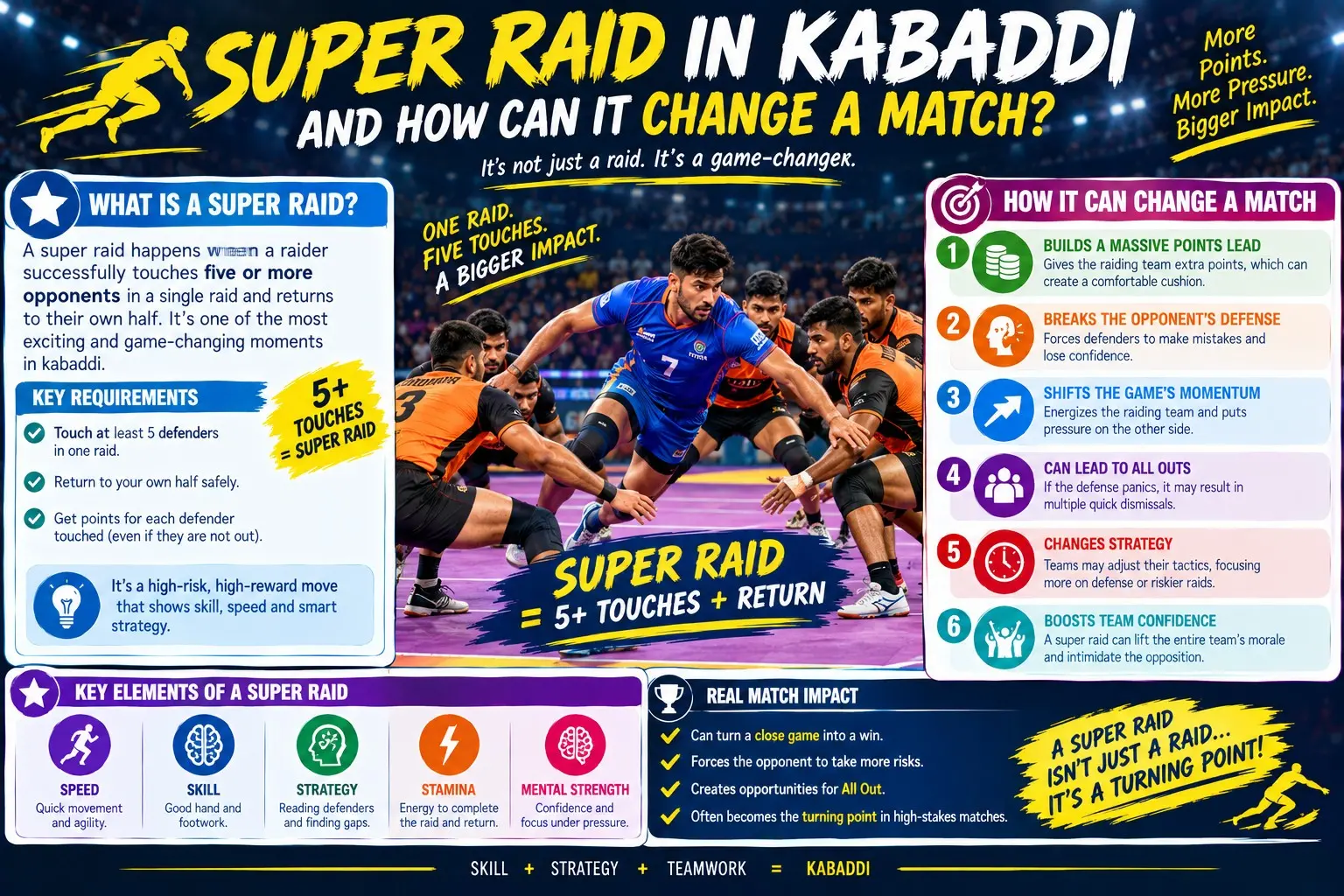
Kabaddi is a sport built on raiding — the rhythmic, breath-held attacks where a lone raider crosses into enemy territory to touch defenders and return home alive. Within that drama, no single play ignites a crowd (or swings a match) like the super raid: one raider, one moment, three or more points ripped from the opposition in a single incursion. In the Pro Kabaddi League (PKL) and international kabaddi, super raids are statistically rare, culturally celebrated, and tactically decisive — capable of transforming a losing position into a winning one within seconds.
This article explains exactly what a super raid is, the rules that define it, how it differs from ordinary raids and all-outs, why it changes matches, and how the best raiders manufacture them.
1. Definition: The Three-Point Raid
A super raid occurs when a raider scores three or more points in a single raid. The points can come from any combination of legitimate scoring methods:
· Touch points — tagging defenders (hand or body touch, with both feet returning to the midline for the point to count).
· Bonus points — crossing the bonus line while enough defenders are present (typically requires 6+ defenders on the mat for men's rules, with foot placement rules governing bonus eligibility).
· Technical points — awarded for defender infringements (e.g., defenders crossing the midline, improper tackles, or out-of-play infractions).
One raid, three or more total points → super raid. There is no requirement that all three come from touches: a raider who grabs two touches plus a bonus, or two touches plus a technical point against the defense, has still recorded a super raid.
By contrast, a raid scoring exactly one or two points is simply a productive raid — valuable, but not "super." The threshold of three is deliberate: single touches are routine; multi-defender takedowns in one breath are not.
2. The Rules Behind the Super Raid
To understand the super raid fully, it helps to anchor it in kabaddi's scoring framework:
How Raid Points Work Generally
· Touch point: The raider must physically touch a defender with any part of the body (hand, leg, torso) and then return to the midline with at least one foot beyond it (both feet across in many rule sets) while keeping the "raid" alive — traditionally accompanied by continuous chanting ("kabaddi, kabaddi") during the cant, though modern professional rules focus on the physical actions within the raid time limit.
· Bonus point: When the defending team has six or more players on the mat (in standard men's PKL rules), the raider can step across the bonus line — a line behind the defenders' half — earning a bonus point if foot placement rules are satisfied, provided they escape with at least a touch point or return safely per bonus mechanics.
· Defenders out: A defender touched and rendered unable to return to their zone before the raider's safe return can be "out" — modern systems award the touch point directly to the raider while "reviving" teammates follows all-out and revival rules.
· Raid duration: Each raid is time-limited (typically 30 seconds in PKL rules) — the raider must attempt and complete action within the window.
Why Three Points Is Special
Ordinary successful raids produce one point (a single touch or bonus). Two-point raids happen regularly when a raider tags a defender while the defense commits an infringement — or tags two players. Three-plus point raids require the raider to overwhelm multiple defenders simultaneously — beating the cover defenders, the corners, or an entire chain in one sequence of movement. The defensive structure of kabaddi — coordinated chains, dashes, and blocks — is designed precisely to prevent this, which is why succeeding is so rare and so celebrated.
Related Terminology
· Super 10: A raider scoring 10 or more raid points in a match (touches + bonuses) — an individual performance milestone, distinct from the single-raid super raid.
· Do-or-die raid: After two successive empty raids, the next raid is compulsory — the raider must score or is out. Super raids sometimes emerge from do-or-die pressure when defenses overcommit.
· All-out: When an entire defending team is eliminated (all players out), the attacking team earns bonus points (typically 2 in PKL) and the defense is fully revived — related but different from a super raid, which scores without requiring full team elimination.
· Super tackle: The defensive mirror — when fewer than three defenders successfully tackle a raider, they earn 2 points instead of 1.
Understanding these distinctions clarifies the kabaddi scoring ecosystem: super raids are one of several multi-point mechanisms, but uniquely tied to a single raider's individual brilliance.
3. How a Super Raid Changes a Match
The impact of a super raid operates on three levels: mathematical, tactical, and psychological.
Mathematical Impact: Swings in Score Differential
Kabaddi matches are often tight, with points earned grindingly — one touch at a time, bonus attempts, defensive tackles. A super raid injecting three or more points in seconds can:
· Flip a trailing position: A team down by 4–5 points suddenly faces a deficit of 1–2 — within a single sequence's reach of parity.
· Create separation: Extending a narrow lead beyond two scores forces the opponent to take desperate risks in subsequent raids.
· Trigger all-out chains: Multi-point raids frequently strip a defense of multiple players, leading directly to all-outs (additional points) on subsequent raids — the "avalanche effect" where one super raid yields four or five total points across consecutive plays.
Match data from PKL seasons shows that games featuring super raids disproportionately include momentum swings of 6+ points within 3–4 raids — the cascading consequence of defensive structures having to rebuild after being shattered.
Tactical Impact: Forcing Defensive Restructuring
After conceding a super raid, the defending coach faces immediate decisions:
· Change the defensive chain — new corners, altered cover positions, different marking assignments.
· Call timeouts (where available) to reorganize — burning a timeout is a real strategic cost.
· Adjust raid-order strategy — perhaps deploying a stronger raider earlier to restore points, at the cost of fatigue management.
Crucially, defenses that have just conceded a super raid often become conservative — sitting deeper, gifting easy bonuses, or failing to attempt advanced tackles — which productive raiders exploit ruthlessly. The super raid thus changes not only the score but the behavior of the opposition.
Psychological Impact: Crowd, Confidence, and Fear
Kabaddi arenas (especially PKL venues) are loud, emotional environments. A super raid produces an immediate energy surge — home crowds erupt, the raiding team's body language transforms, and the defense visibly deflates. Sports-psychology research on momentum in team combat sports suggests that spectacular multi-point plays increase the scoring team's subsequent aggression while raising the conceding team's error rate — a self-reinforcing loop.
For the raider personally, a super raid often unlocks freer subsequent raids: defenders hesitate, second-guess tackles, and grant space they would otherwise deny — effectively raising the raider's point yield for the remainder of the match.
4. How Raiders Manufacture Super Raids
Elite raiders who produce super raids consistently share techniques and tactical patterns:
a) Reading the Chain Structure
Kabaddi defenses operate as linked chains — corners holding the edges, covers ready to dash or block. Super-raiders study:
· Chain gaps: Moments when cover defenders are slightly separated from corners during movement.
· Weak links: Defenders slower to respond or out of position after failed tackles.
· Formation timing: Attacking immediately as the defense reorganizes — the seconds after a revival, when placements are fresh and coordination lowest.
b) Multi-Directional Movement
The hallmark of super-raid specialists (think Arjun Deshwal, Pawan Sehrawat-style aggression, or historical greats) is angular, unpredictable footwork: feints toward one corner, a sharp turn to tag the covering defender, momentum carried through to a second touch before the chain collapses. The raider essentially threads multiple touches into one continuous escape route.
c) Bonus-Plus-Touch Combinations
A practical route to three points: secure the bonus first, then extend for a touch while the defense is reacting to the bonus attempt — or tag a defender during the bonus attempt and complete both. Raiders who make defenses fear the bonus create the hesitation that opens touch opportunities.
d) Capitalizing on Do-or-Die and Pressure Raids
Defenses facing a do-or-die raid from the opponent often overcommit — pushing extra defenders forward for a tackle. Super raiders exploit this: baiting the tackle attempt, evading, and tagging exposed players for multi-point sequences.
e) Physical Tools
While technique dominates, physical attributes help: explosive first-step speed to beat chains to the spot, core strength to absorb arm holds while extending touches, and exceptional cardio to maintain raid quality across four quarters of high-intensity play.
5. Super Raids in the Pro Kabaddi League and Beyond
The PKL — India's premier kabaddi competition and one of the country's most-watched sports leagues — has made the super raid a signature highlight:
· Broadcast culture: Super raids feature prominently in league marketing and highlight packages — the kabaddi equivalent of the six-hit or slam-dunk moment.
· Statistical tracking: PKL official rules and statistical outputs track super raids alongside super 10s, super tackles, and all-outs — analysts correlate super-raid frequency with team win rates across seasons.
· International kabaddi: The Asian Games and Kabaddi World Cup formats use analogous scoring — multi-point raids occur under different structural pressures (national-team defensive discipline often being higher), making them proportionally even more decisive.
Data patterns suggest super raids are more frequent in high-tempo matches with aggressive raiding strategies — teams that raid proactively to create opportunities rather than purely to survive produce more multi-point sequences.
6. Defensive Perspective: How Teams Prevent Super Raids
Understanding the super raid also means understanding defensive counter-strategies:
· Chain integrity: Maintaining constant physical and visual contact between corner and cover defenders eliminates the gaps raiders exploit.
· No over-commitment: Avoiding double-team attempts unless certain — the failed double leaves two defenders exposed for tags.
· Dash timing: Coordinated dashes (defenders charging laterally to push raiders out) executed by two players together rather than solo lunges.
· Bonus denial: Proper bonus-line positioning and foot-block techniques to remove the "bonus-plus-touch" combination route.
· Tackle discipline: Sliding holds low, targeting the raider's return path rather than lunging at feints — fundamentally, refusing to be baited.
Elite defensive units go entire matches without conceding a super raid — the mark of championship-level coordination.
7. Common Misconceptions
· "Any multi-point raid is a super raid." No — the threshold is three points. Two-point raids, however flashy, do not qualify.
· "Super raids only count touch points." Bonuses and technical points count toward the three-point total.
· "Super 10 = super raids." A super 10 is a match aggregate milestone; a super raid is a single-play event. A player can score a super 10 without ever recording a super raid.
· "Super raids are pure luck." While chaos contributes, film study of serial super-raid producers reveals deliberate patterns — chain-reading, feint sequencing, and bonus manipulation — making them a trainable skill.
8. Why Fans Love the Super Raid
Ultimately, the super raid distills kabaddi's appeal into one sequence: courage (one raider against many), athleticism (evasion under contact), and sudden transformation (three points from nothing). It is basketball's fast break, cricket's six-hitting spree, and football's counter-attack rolled into a single breath-held incursion. In a sport where every raid carries risk of elimination, the raider who tags three and escapes home has performed an act of controlled audacity — and matches, seasons, and careers are remembered for exactly those moments.