

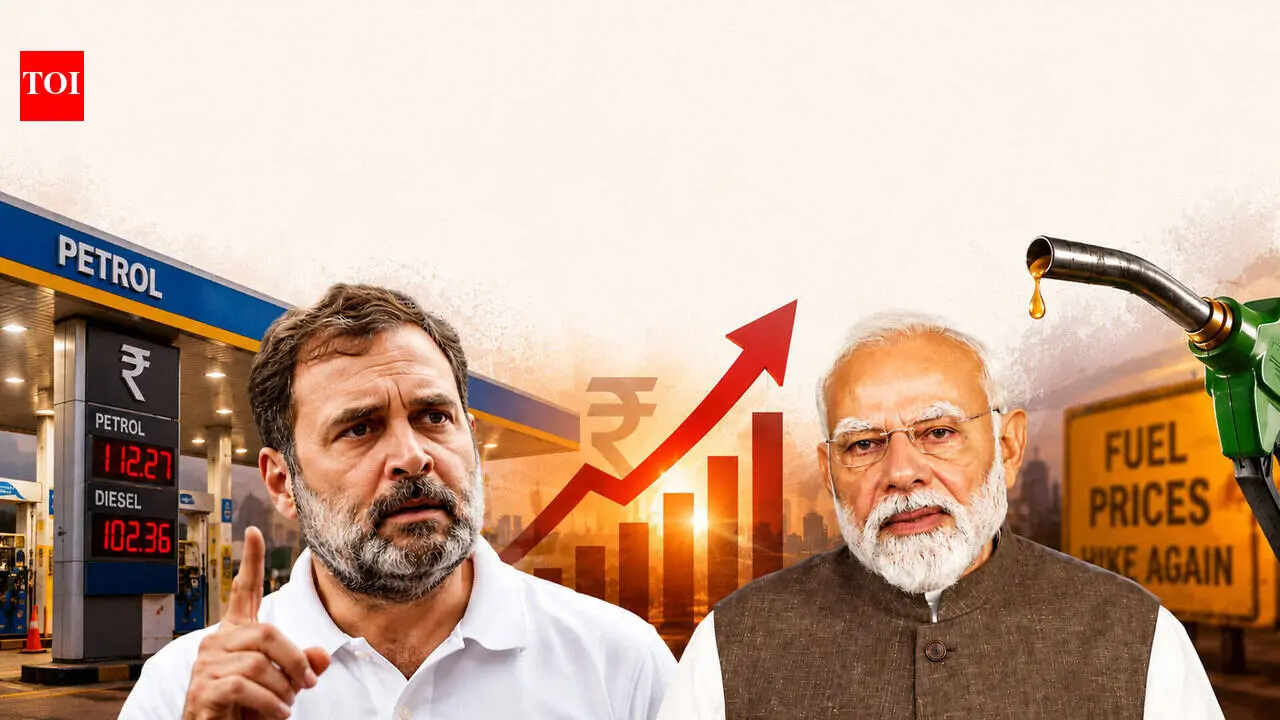
Fuel prices in India have been increased for the third time in just 10 days, with petrol, diesel and CNG becoming costlier again on Saturday. This latest hike has reignited a political firestorm, with the Congress party launching a blistering attack on Prime Minister Narendra Modi, accusing his government of systematically fleecing citizens while prioritizing the profits of state-owned oil companies.
Congress Calls Modi 'Mehengai Man Modi'
The Congress party, led by Rahul Gandhi and other senior leaders, has coined the term 'Mehengai Man Modi' (Inflation Man Modi) to highlight what they call the government's failure to control rising prices. In a series of statements, Congress spokespersons alleged that the Modi administration is deliberately increasing fuel taxes to compensate for corporate tax cuts given to big businesses. They claimed that ordinary Indians are being forced to bear the burden of government mismanagement and pro-corporate policies.
Congress pointed out that the latest price revision comes despite the government's repeated promises to stabilize fuel costs. The party demanded that the central government immediately reduce excise duties on petrol and diesel, which have been hiked multiple times since 2014. They also called for bringing petrol and diesel under the Goods and Services Tax (GST) regime to ensure uniform pricing and lower rates.
Third Hike in Ten Days: The Numbers
The price of petrol in Delhi crossed the Rs 100 per litre mark in several cities, with diesel also hovering near that level. According to data from the Indian Oil Corporation, petrol prices have risen by nearly Rs 2.50 per litre over the past ten days, while diesel has increased by about Rs 2 per litre. CNG prices, which are linked to both domestic and international gas benchmarks, have seen an even steeper rise. This has particularly impacted transport operators and households that rely on CNG for cooking and vehicles.
The government has not yet officially commented on the Congress's allegations, but Ministry of Petroleum officials have indicated that the price adjustments reflect the volatile global crude oil market. India imports approximately 85% of its crude oil requirements, making domestic prices highly sensitive to international fluctuations. The recent spike in global crude prices is largely attributed to escalating tensions involving Iran, a major oil producer, and concerns over supply disruptions in the Middle East.
Global Context: Iran Tensions and Crude Prices
The latest fuel price hike coincides with a sharp increase in global crude oil benchmarks. Brent crude, the international reference, has surged past $90 per barrel, reaching levels not seen in several years. This rally is driven by multiple factors: the ongoing conflict between Israel and Hamas, which has raised fears of a wider regional war; the United States' tightening sanctions on Iranian oil exports; and production cuts by OPEC+ nations led by Saudi Arabia and Russia.
India, as a major consumer, has been trying to balance its energy security needs with diplomatic pressures. The country has continued to purchase Russian crude oil at discounted rates despite Western sanctions, a policy that has drawn criticism from the United States and European allies. However, the government argues that ensuring affordable energy for 1.4 billion citizens is its supreme priority. This stance has led to occasional friction with Washington, as reflected in recent trade disputes over Russian oil.
Political Fallout: Opposition Unity on Fuel Prices
The Congress attack is part of a broader opposition strategy to corner the Modi government on economic issues ahead of upcoming state elections. Several other opposition parties, including the Aam Aadmi Party (AAP), the Trinamool Congress, and the Left parties, have also condemned the price hike. They have announced plans to hold nationwide protests and 'fuel price agitation' days. In the Lok Sabha, opposition MPs have disrupted proceedings, demanding a debate on the steep rise in fuel prices and its impact on inflation.
The ruling Bharatiya Janata Party (BJP) has defended the government's record, pointing out that the central excise duty on petrol and diesel was actually reduced in November 2021 by Rs 5 per litre and Rs 10 per litre respectively, and that the recent price hikes are purely a result of global factors. The BJP also accused Congress of playing politics while the nation faces economic challenges due to the Russia-Ukraine war and global supply chain disruptions. Nonetheless, the opposition narrative of 'Mehengai' (inflation) appears to be resonating with the public, especially in urban areas where fuel costs directly impact household budgets.
Economic Impact: Ripple Effects Across Sectors
The repeated fuel price hikes are having a cascading effect on the Indian economy. Transportation costs have risen, leading to higher prices for essential commodities like vegetables, milk, and pulses. Many state transport corporations have increased bus fares, putting additional burden on daily commuters. The logistics sector, which contributes significantly to GDP, is also witnessing higher operational costs, which are eventually passed on to consumers.
Small and medium enterprises (SMEs) that rely on diesel generators for power in areas with erratic electricity supply have been particularly hard hit. The hospitality and tourism industry, which was recovering from pandemic losses, now faces renewed cost pressures. Economists warn that sustained high fuel prices could push the wholesale price index (WPI) and consumer price index (CPI) higher, potentially forcing the Reserve Bank of India (RBI) to reconsider its interest rate stance.
Historical Perspective: Fuel Pricing in India
India's fuel pricing mechanism has evolved over the years. Until 2010, petrol and diesel prices were administered by the government, with subsidies shielding consumers from global price volatility. However, following the deregulation of petrol in 2010 and diesel in 2014, state-owned oil marketing companies (OMCs) now revise prices daily based on a 15-day average of international benchmark prices and the rupee-dollar exchange rate. The government, however, still controls the excise duty and Value Added Tax (VAT) rates, which vary from state to state.
Since 2014, the central government has increased excise duty on petrol and diesel multiple times, initially to boost revenues and later to fund infrastructure projects. Critics argue that this has made Indian fuel prices among the highest in the world, even when crude prices are low. The current tax component accounts for nearly 50-60% of the retail price, depending on the state. In contrast, countries like the United States have far lower taxes on fuel, though their crude dependence is similar.
What Lies Ahead? Supply Concerns and Diplomatic Maneuvering
Looking forward, analysts predict that global crude prices may remain elevated in the near term due to the Iran situation and OPEC+ production discipline. India is exploring alternative sources, including increasing imports from the U.S., Brazil, and Guyana, but these are not yet at sufficient scale. The government has also accelerated its push for renewable energy and electric vehicles, but the transition is expected to take years.
On the diplomatic front, Prime Minister Modi has been actively engaging with leaders of oil-producing nations, including Saudi Arabia's Crown Prince Mohammed bin Salman and Russia's President Vladimir Putin. The recent SCO summit highlighted India's balancing act between Western allies and energy suppliers. Meanwhile, the U.S. has been pressuring India to reduce its dependence on Russian oil, but New Delhi has maintained that its energy purchases are purely commercial and not subject to geopolitical dictates.
At home, the political battle over fuel prices is far from over. With state elections in several key states approaching, the opposition is expected to keep the issue alive. The Congress party's sharp critique of Modi over the 'Mehengai' tag is likely to intensify, especially if global crude prices continue to rise. The government, on its part, may consider another excise duty cut as a pre-election sop, but such a move would strain its fiscal deficit targets.
The fuel price hike saga thus intertwines domestic politics, global economics, and energy security—a complex mix that will shape India's policy discourse in the coming months. As citizens grapple with rising costs, all eyes are on the government's next move.
Source: The Times of India News