

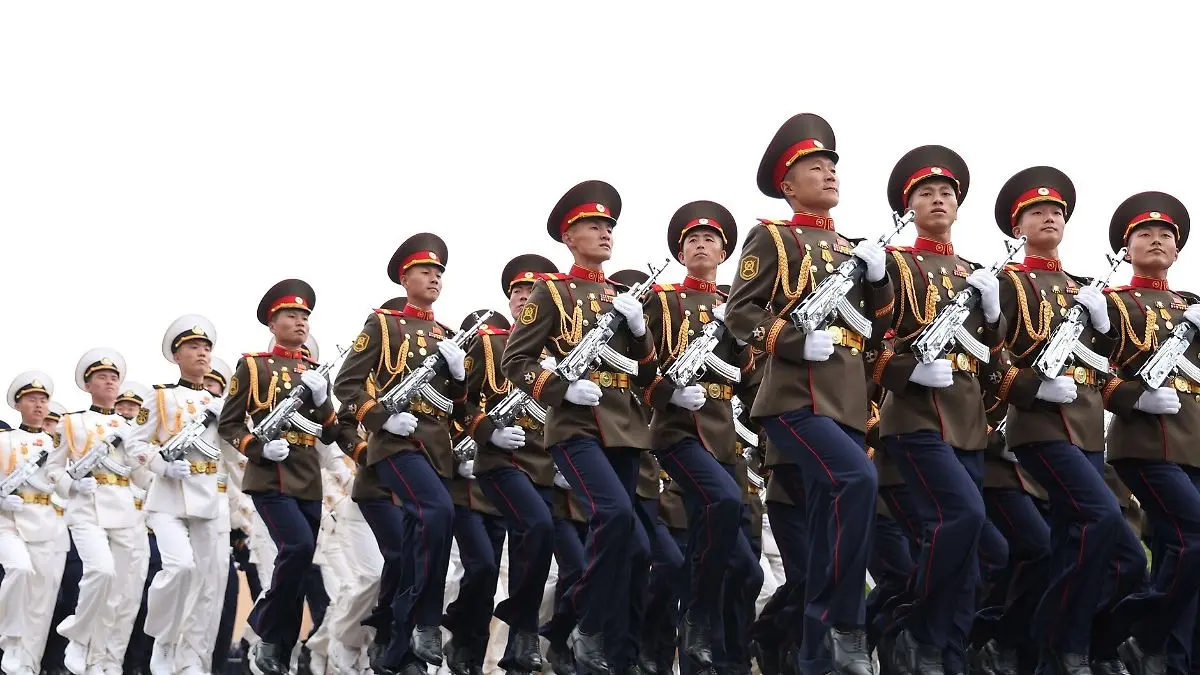
North Korean leader Kim Jong Un has directed top military commanders to significantly reinforce the border with South Korea, state media reported on Tuesday. According to the Korean Central News Agency (KCNA), Kim convened a high-level meeting with senior military officials to discuss what he termed the "territorial defense policy" of the ruling Workers' Party. The goal, the report stated, is to "strengthen front-line units along the southern border and transform the boundary into an impregnable fortress." KCNA published a photograph showing Kim standing before generals in parade uniforms, underscoring the ceremonial yet serious nature of the gathering.
During the meeting, Kim stressed the need for a "great change" to avert a potential war. He urged the commanders to sharpen their "attitude toward the arch enemy," a thinly veiled reference to South Korea, which Pyongyang has increasingly characterized as its primary adversary. The North Korean leader also discussed "plans to reinforce front-line troops and other key units in military-technical terms as an important decision for more effective war deterrence." Projects for modernizing the military should be "accelerated" to "redefine the operational concept in all areas," Kim was quoted as saying.
This latest directive comes against a backdrop of steadily deteriorating inter-Korean relations. In March of this year, Kim publicly designated South Korea as "the most hostile state" and called for a fundamental shift in how North Korea deals with its southern neighbor. The regime has dismantled symbols of reconciliation, including the unification monument in Pyongyang, and has severed all official communication channels with Seoul. Analysts believe Kim's bellicose language serves multiple purposes: consolidating domestic support, justifying military spending, and putting pressure on the United States and South Korea ahead of any potential negotiations.
The border between North and South Korea remains one of the most heavily militarized in the world, with hundreds of thousands of troops stationed on both sides, separated by the Demilitarized Zone (DMZ). Despite its name, the DMZ is a hotbed of military activity, dotted with observation posts, landmines, and fortified outposts. Incidents such as the 2010 shelling of Yeonpyeong Island and the 2015 landmine explosions have shown how quickly tensions can escalate into violence. Kim's latest move to reinforce the border raises concerns that minor skirmishes could spiral into a larger conflict, especially given the current rhetoric emanating from Pyongyang.
Historically, North Korea has used military brinkmanship as a negotiating tactic. By heightening tensions, the regime seeks to extract concessions from South Korea and the United States, such as sanctions relief or security guarantees. However, Kim's strategy appears to have shifted in recent years. While he met with former President Donald Trump and South Korean President Moon Jae-in, those diplomatic efforts ultimately collapsed over disagreements on denuclearization and sanctions. Since then, North Korea has focused on weapons development, including intercontinental ballistic missiles and tactical nuclear weapons, while hardening its stance toward the South.
The concept of "war avoidance" as articulated by Kim is a familiar contradiction in North Korean statecraft. The regime often frames its aggressive military postures as defensive measures meant to prevent invasion. By deploying more troops and modernizing equipment, Pyongyang claims it is protecting itself from hostile forces, particularly the United States and South Korea. However, outside observers see these actions as provocative and destabilizing. The United Nations Command, which oversees the armistice that ended the Korean War, called for restraint, urging both sides to adhere to the 1953 armistice agreement. South Korea's Ministry of Defense warned that any provocation would be met with a strong response and emphasized that Seoul maintains a robust defense posture in coordination with U.S. forces.
Analysts have noted that Kim's emphasis on military-technical modernization is part of a broader push to enhance North Korea's deterrence capabilities. The country has test-fired numerous missiles this year, including hypersonic and solid-fuel systems, and has unveiled new warheads designed to penetrate missile defense systems. At the meeting, Kim reportedly called for redefining operational concepts across all branches of the military, suggesting a move toward more integrated and technologically advanced combat units. This modernization drive comes as North Korea faces severe economic challenges due to international sanctions, natural disasters, and a prolonged COVID-19 lockdown that cut off cross-border trade with China.
Domestically, the border reinforcement serves to rally the population behind the regime. North Korean propaganda has long portrayed the South as a puppet of the United States and a source of moral decay. By emphasizing the threat from the South, Kim can justify the continued militarization of society, the diversion of scarce resources to the military, and the suppression of any dissent that might be inspired by news of South Korea's relative prosperity. The KCNA report did not mention any specific timeline for the reinforcement, but it is expected that additional troops, artillery, and fortified positions will be visible along the border in the coming weeks.
The international community has reacted with concern. The United States, which stations approximately 28,500 troops in South Korea, reaffirmed its commitment to the defense of its ally. A State Department spokesperson called on North Korea to cease provocative actions and return to dialogue. China and Russia, which have historically supported North Korea, urged restraint from all sides. Beijing called for a political solution and warned against any actions that could lead to instability on its northeastern border. Meanwhile, the European Union expressed deep concern and called for de-escalation.
Kim's latest move also comes ahead of joint U.S.-South Korea military exercises, which are scheduled to take place later this year. Pyongyang has long condemned these drills as rehearsals for invasion, even though Seoul and Washington describe them as defensive in nature. The reinforcement may be a preemptive show of force aimed at raising the stakes before the exercises occur, or it could be a signal that North Korea is preparing to test a nuclear device or launch a satellite. The country has completed preparations for a seventh nuclear test at its Punggye-ri testing ground, according to intelligence assessments, and the timing of such a test could be tied to political or military events.
In summary, Kim Jong Un's order to increase troop numbers and strengthen the border represents a significant escalation in the already fraught relationship between North and South Korea. By framing the move as a measure to avert war, the regime attempts to portray itself as both the aggressor and the victim, a paradoxical stance that has characterized North Korean diplomacy for decades. The coming weeks will reveal whether this is merely a rhetorical exercise or a precursor to more dramatic actions on the Korean Peninsula. The world watches as one of the last flashpoints of the Cold War edges ever closer to a potential flashpoint.
Beyond the immediate military implications, Kim's decision reflects a deeper strategic recalibration. North Korea no longer seeks to engage with the South as a partner in reconciliation but rather as an enemy to be contained and intimidated. The dismantling of the inter-Korean liaison office in 2020, the termination of the 2018 military agreement, and the current reinforcement of the border all point to a new policy that prioritizes unilateral military advantage over dialogue. This shift has prompted South Korea's government to bolster its own defenses and seek stronger assurances from the United States, including the deployment of additional strategic assets like aircraft carriers and nuclear-capable bombers on rotation.
The economic toll of this renewed confrontation is significant. Both Koreas spend heavily on national defense, diverting funds from social programs and infrastructure. For North Korea, the opportunity cost is even steeper, as the regime's focus on military strength comes at the expense of the struggling civilian economy. Sanctions remain tight, and the country continues to suffer from food shortages and energy deficits. Kim's prioritization of the military over the welfare of his people is a calculated risk, betting that a strong military posture will eventually force concessions from the international community. Whether this gamble pays off remains uncertain, but for now, the Korean Peninsula appears headed for a period of heightened tension that could test the resilience of regional stability.
Source: ntv.de News