

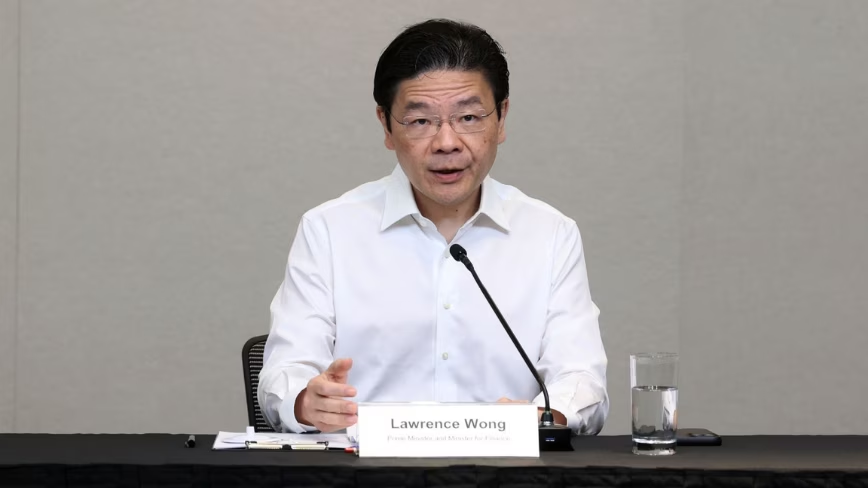
Singapore's Prime Minister Lawrence Wong has firmly held the line on one of the most pressing questions of the modern economy: whether artificial intelligence will create growth without jobs. In a parliamentary reaffirmation on Wednesday, Wong reiterated that his government will ensure AI deployment in Singapore does not lead to what economists call “jobless growth.” The statement, first made during the February 2026 Budget debate, marks the most explicit commitment a major Asian economy has yet made on the AI-and-employment question.
Wong's framing has been consistent since his 26 February speech. Addressing MPs who voiced concerns about worker anxieties around AI, the Prime Minister stated that the government would harness AI to grow the economy while ensuring that growth translates into good jobs and better wages. “These concerns are real and we must and we will take them seriously,” he said in response to opposition and backbench questions. The substantive question now is whether Singapore can deliver on that pledge in practice.
The Prime Minister identified three specific concerns that MPs had raised: that greater AI use could reduce employer investment in worker training; that older workers re-entering the workforce would face disproportionate barriers; and that entry-level professional and technical jobs could be hollowed out before structural responses can take effect. Wong said the government would act early to prevent each outcome rather than respond after the fact. This proactive stance is central to Singapore's approach to managing technological disruption.
Current labour-market figures are favourable. The proportion of permanent employees in Singapore has reached a record high of nearly 91 per cent, with gains across most sectors. Job vacancies continue to outnumber job seekers, with more than 40 per cent of openings being entry-level professional, manager, executive, and technician roles. That is the kind of base from which a no-jobless-growth pledge is plausible to make. However, the harder question is whether the pattern persists as AI deployment accelerates across industries.
Wong has paired the rhetorical commitment with concrete programme spending. The Champions of AI programme will provide tailored support, including enterprise transformation and workforce training, for firms aspiring to undertake comprehensive AI-driven business transformation. Four national AI missions have been identified across advanced manufacturing, connectivity and logistics, finance, and healthcare. A National AI Council oversees the development at the national level, ensuring coordination across government agencies, industry, and academia.
The labour movement has responded with its own policy demands. Labour MPs aligned with the National Trades Union Congress (NTUC) have called for AI-ready career pathways, stronger job-transition support for displaced workers, and explicit measures to ensure that AI-augmented workplaces remain inclusive of older and lower-skilled employees. The NTUC has historically operated in close alignment with the ruling People's Action Party, and its parallel framing of the AI question reinforces rather than contests Wong's position. This alignment is significant because it signals broad consensus within Singapore's political and labour infrastructure on the need for proactive intervention.
The wider economic context is also relevant. Wong's February budget was framed around what the government has begun describing as “a more dangerous world,” with explicit reference to global trade fragmentation, US-China commercial tensions, and the broader uncertainty AI is introducing into white-collar labour markets across advanced economies. His May Day Rally speech continued to use the AI-and-employment frame as one of the principal pillars of his government's medium-term policy positioning. Singapore, as a small open economy highly dependent on global trade and investment, must navigate these external headwinds while managing internal technological shifts.
What the pledge does not specify is what counts as “jobless growth” or what triggers a government intervention if the pattern emerges anyway. The technical definition matters because Singapore's labour-market structure is unusually responsive to government-led adjustment, with active labour-market programmes, employer subsidies, and migration policy all available as policy instruments. Wong's commitment is, in effect, a promise that those instruments will be deployed proactively if the AI-deployment cycle starts to produce the structural pattern the pledge rules out. However, without clear metrics or benchmarks, the pledge remains largely rhetorical until tested by data.
The credibility test will be empirical. If Singapore's overall employment rate, real wage growth, and entry-level hiring volumes all hold through the next several years of AI deployment, the no-jobless-growth pledge will look prescient. If they do not, Wong's government will face the political question of whether the policy framework moves fast enough to deliver on the commitment in practice. Wednesday's parliamentary reaffirmation suggests the government is treating the question as a long-cycle commitment rather than a one-off rhetorical position.
Singapore's approach to AI and employment is being watched closely by other economies in the region, particularly those that are heavily reliant on manufacturing and services. The city-state has historically succeeded in reinventing its economy through strategic state intervention, from the shift to high-tech manufacturing in the 1980s to the push for a knowledge-based economy in the 2000s. Now, with AI poised to disrupt white-collar jobs across finance, law, logistics, and healthcare, the government is once again positioning itself as a proactive manager of technological transitions.
The Champions of AI programme, announced alongside the budget, is a key pillar of this strategy. It provides grants, consultancy, and training subsidies to companies that commit to large-scale AI transformation. Eligible firms can receive up to 50 per cent co-funding for AI implementation projects, with additional support for workforce upskilling. The programme targets small and medium enterprises (SMEs) in particular, as they often lack the resources to adopt AI independently. By encouraging SMEs to integrate AI, the government aims to boost productivity while ensuring that workers are trained to operate alongside intelligent systems.
The four national AI missions cover advanced manufacturing, where AI can optimize supply chains and predictive maintenance; connectivity and logistics, which includes smart ports and autonomous delivery systems; finance, with applications in fraud detection, credit scoring, and robo-advisory; and healthcare, where AI assists in diagnostics, drug discovery, and patient management. A National AI Council, comprising ministers, industry leaders, and academic experts, oversees progress and coordinates cross-sector initiatives. This council reports directly to the Prime Minister's Office, underscoring the priority given to AI governance.
Education and training are also undergoing overhaul. The government has expanded its SkillsFuture programme to include AI-specific modules, and the Institute of Technical Education (ITE) and polytechnics have introduced new courses in prompt engineering, data analytics, and machine learning. Workers in sectors most vulnerable to automation, such as customer service and administrative support, are being offered targeted retraining programmes with income support during the transition period. The NTUC has also launched a “Job Security through Skills” initiative, which provides career counseling and placement services for displaced workers.
Despite these efforts, challenges remain. The fast pace of AI development means that training curricula may quickly become outdated. Small firms may struggle to find the right talent to implement AI solutions, even with government subsidies. Moreover, older workers, who may have less digital literacy, could find it harder to adapt. The government has acknowledged these risks and is piloting schemes that pair older workers with younger digital mentors in workplace settings. Early results from these pilots show promise, with older workers reporting increased confidence in using AI tools.
On the macroeconomic front, Singapore's status as a global hub for financial services and trade makes it particularly exposed to the AI-driven transformation of those industries. Banks like DBS and OCBC have already deployed AI for customer service chatbots and anti-money laundering systems. Law firms are using AI for document review. Logistics companies are piloting autonomous vehicles and drones for last-mile delivery. These developments create efficiencies but also raise questions about the future of entry-level jobs that typically served as stepping stones for young graduates.
The government's response has been to encourage companies to view AI not as a replacement for workers but as a complement. The Ministry of Manpower has issued guidelines on AI and employment, recommending that employers involve workers in the design and implementation of AI systems, provide retraining opportunities, and avoid using AI solely to reduce headcount. While these guidelines are not legally binding, they set a normative standard that most large employers in Singapore follow due to the government's influence over industry.
International comparisons are instructive. In the United States, there have been high-profile layoffs at tech companies that have invested heavily in AI, leading to fears of widespread job displacement. In Europe, policymakers are grappling with the AI Act and its implications for employment. Singapore's approach is distinct in its emphasis on preemptive action and social partnership. By pledging no jobless growth, the government is setting a high bar for itself, but it may also provide a model for other economies seeking to balance innovation with inclusion.
As AI continues to evolve, the real test will be whether Singapore can maintain its record of low unemployment and rising wages while embracing automation. For now, the Prime Minister's words have been backed by policy, and both unions and businesses are aligned. The coming years will reveal whether that alignment is sufficient to keep the pledge intact.
Source: TNW | Government-Policy News