

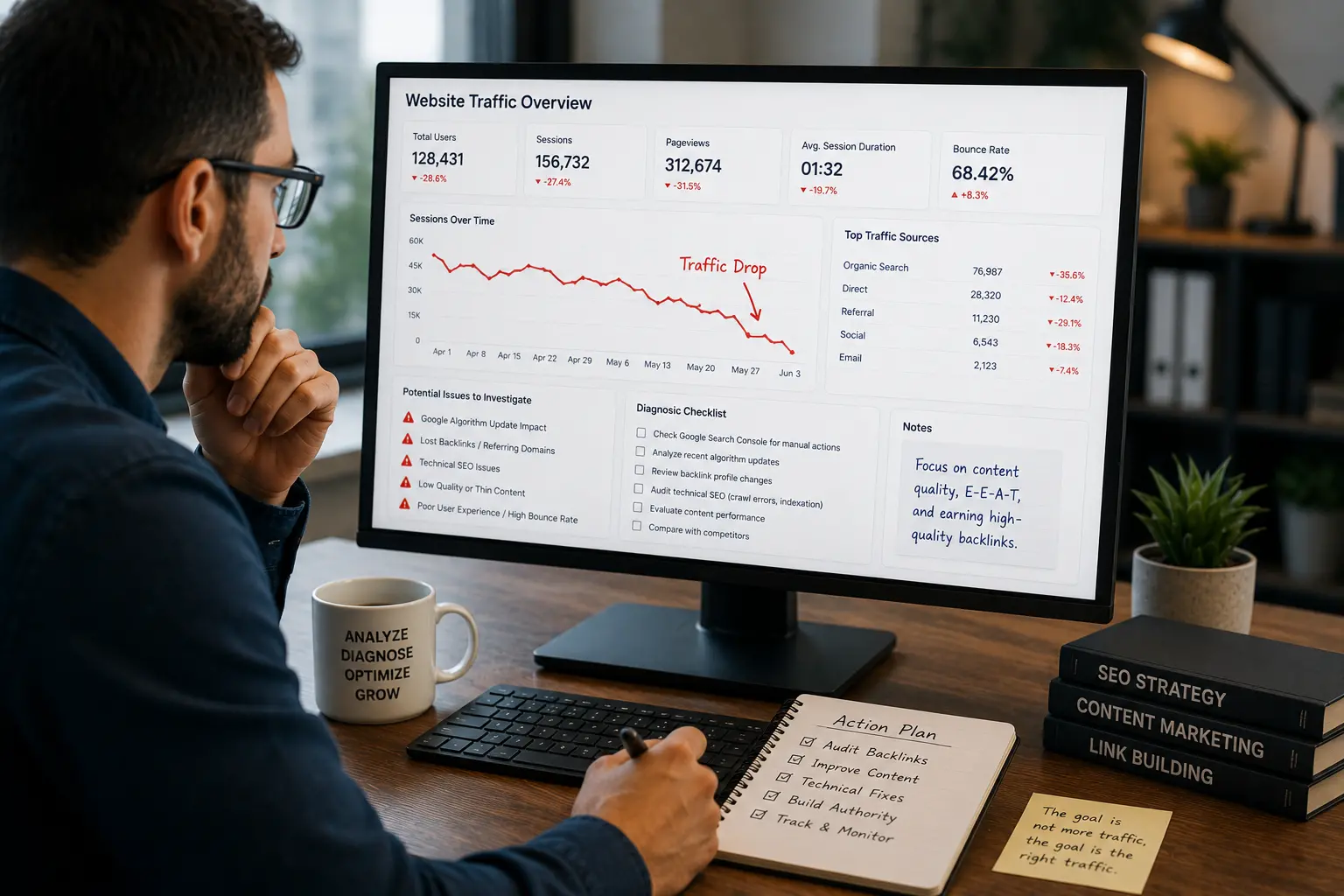
TL;DR: A website traffic drop usually stems from search engine algorithm updates, technical errors, or a loss of high-quality backlinks. To fix it, audit your technical SEO, verify your site's health in search consoles, and rebuild authority using a reliable Guest Post Agency to secure White Hat Guest Posting links.
Waking up to a downward-sloping line in your analytics is enough to make any site owner's heart sink. I've been there, staring at a screen while 30% of my daily visitors simply vanished overnight. It feels personal, but in most cases, it's just the web's ecosystem shifting beneath your feet. Understanding why your traffic dipped is the first step toward a recovery that actually sticks. Usually, the culprits are hidden in your link profile or a sudden change in how search engines view your content.
What Is a Website Traffic Drop?
Website Traffic Drop: A significant, often sudden decrease in the number of visitors reaching a site, typically caused by ranking losses, technical penalties, or seasonal shifts.
When we talk about a drop, we aren't talking about a quiet Sunday afternoon where numbers dip slightly. We are talking about a sustained trend where your top-performing pages stop appearing for the keywords they once owned. It’s a signal that the "trust" your domain once held has been questioned. To regain that ground, many businesses turn to Guest Posting for SEO to inject fresh, high-authority signals back into their URL.
Why Traffic Maintenance Matters
The web is noisier than ever. In 2026, search engines have moved beyond simple keyword matching; they now prioritize the "source" as much as the "information." If your traffic is falling, it’s likely because a competitor has more High Authority Backlinks or because your brand’s digital footprint has grown stale.
What most people overlook is that maintaining traffic isn't just about writing new blogs. It's about protecting the moat around your existing rankings. If you aren't actively engaged in Guest Post Outreach to maintain a steady flow of fresh signals, your older content naturally loses its "freshness" score. Think of it like a garden; if you stop watering it (or building new links), it eventually wilts.
How to Diagnose a Traffic Drop — Step by Step
Rule out technical glitches. Before you panic about SEO, check your tracking code. I once spent three hours mourning a "traffic death" only to realize a developer had accidentally removed the tracking script during a site update. Check your robots.txt file to ensure you haven't accidentally blocked search engines from crawling your most important pages.
Check for manual actions. Head to your search console. If you've been using "black hat" tactics, you might see a notification there. However, if you’ve stayed clean with White Hat Guest Posting, this section will likely be empty.
Analyze the "Top Pages" report. Identify exactly which pages lost traffic. Was it your homepage, or a specific set of service pages? If it's specific pages, the issue might be content decay or a competitor out-optimizing you.
Audit your backlink profile. Use a tool to see if you recently lost several Dofollow Guest Posts or if a high-DA site went offline. Sudden losses in link equity are a leading cause of ranking drops.
Compare dates with algorithm updates. Search engines change their rules constantly. If your drop aligns perfectly with a known update, you need to adjust your strategy to match the new quality standards.
The Counterintuitive Truth: Losing Traffic Might Be Good
Here is my hot take: sometimes, a traffic drop is a blessing in disguise. Let me be direct—if you were ranking for thousands of "junk" keywords that brought in visitors who never bought anything, losing that traffic cleans up your data.
In my experience, I’ve seen sites lose 20% of their "top-of-funnel" traffic but see their conversion rates double. Why? Because the search engine finally figured out who the site was actually for. Instead of chasing raw numbers, you should be chasing Niche Guest Posts that bring in relevant, high-intent readers. Don't obsess over the quantity of the crowd if the crowd wasn't buying what you were selling.
Expert Tips: What Actually Works for Recovery
If you want to bounce back, stop looking for "hacks." What actually works is a return to fundamentals. Start by identifying the gaps in your authority. If your competitors have been using a Guest Post Agency to secure spots on Premium Guest Posting Sites, you simply cannot compete by staying silent.
I've seen this work time and again: focus on Manual Outreach Guest Posting. Don't just Buy Guest Posts from a spreadsheet that everyone else has access to. You want links from sites that actually have their own traffic. A single link from a high-traffic, relevant site is worth more than fifty links from "zombie" sites.
Another thing—mix up your anchor text. Most beginners make the mistake of using their primary keyword as the link text every single time. It’s a huge red flag. Use branded terms, generic phrases, and long-tail variations to keep things looking natural.
Best Press Release Submission Platforms for SEO & Brand Visibility
When your traffic drops, you need to broadcast your brand's stability and new developments to the world. Using press release distribution sites is a powerful way to generate immediate "noise" and high-authority signals. Unlike a standard blog post, a press release is picked up by news distribution platforms, creating a massive wave of online PR marketing that search engines can't ignore.
Working with a dedicated press release agency helps ensure your news is formatted correctly for journalist pickup. The primary benefit here is the sheer diversity of the link profile you build. You get a mix of nofollow and dofollow links from highly trusted news domains. These PR submission sites act as a catalyst, often helping your Guest Post Backlinks perform better because your overall brand authority has increased. It’s about building a multi-layered defense for your traffic.
People Most Asked about Website Traffic Drops
How long does it take to recover from a traffic drop?
In most cases, you’re looking at two to four months. It takes time for search engines to recrawl your site and recognize the improvements you’ve made, especially if you are rebuilding authority through High DA Guest Posting.
Can bad backlinks cause a sudden drop?
Yes, absolutely. If your site is hit with a "spam attack" or if you previously used low-quality services, search engines might devalue your entire link profile. This is why sticking to White Hat Guest Posting is the only safe long-term play.
Should I delete content that lost traffic?
Probably not immediately. It's usually better to "refresh" it. Update the statistics, add new expert insights, and perhaps secure some fresh Guest Posting for SEO to give that specific page a boost.
Is Guest Post Link Building still safe?
It's safe as long as it's manual. The danger comes from automated systems. If you use a Guest Post Agency that focuses on real relationships and Manual Outreach Guest Posting, it remains one of the most effective ways to rank.
Why is my traffic dropping but my rankings are the same?
This usually means "search volume" for your keywords has decreased. It could be seasonal (like people searching less for "winter coats" in July) or a shift in how people phrase their queries.